
Telling the Truth Today
Brandon Sun, January 13, 2020 - David McConkey
How do you know what is
true? How do you tell others about the truth? How do you tell your
story? What if you are talking to another person who believes
something that seems untrue? Can you change their mind? Are you open
to changing your mind? Two recent books explore these topics. And
they say much about the time we live in.
The first book is The Art of Memoir by Mary Karr. Written in
2015, it reveals a simpler, more carefree time. Remember? Before the
Trump era with its disinformation, conspiracy theories, “alternative
facts” and “fake news”?
Karr refers to a word that comedian Stephen Colbert coined in 2005:
“truthiness.” That retort from before the Trump era appears
downright playful now compared to our daily grind of “post-truth”
trolling, gaslighting and “weaponizing.” And where we are today
divided into warring tribes, echo chambers and filter bubbles.
 Karr is an American memoirist, poet and literature professor. She
demonstrates how to tell a story well, including gritty vignettes of
her own hard-scrabble past. Readable and usable, the book would be
ideal if you aspire to write your own memoir or if you enjoy reading
memoirs.
Karr is an American memoirist, poet and literature professor. She
demonstrates how to tell a story well, including gritty vignettes of
her own hard-scrabble past. Readable and usable, the book would be
ideal if you aspire to write your own memoir or if you enjoy reading
memoirs.
The second book, written in 2019, is imbued with the tension and
unease of the Trump era. The book is presented as a corrective and
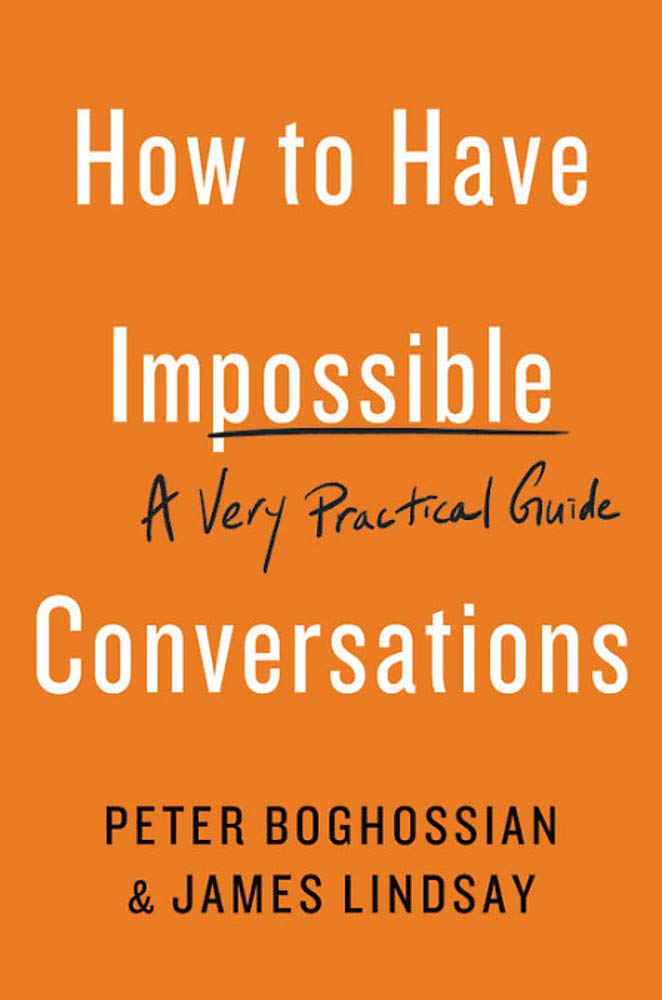
is titled How to Have Impossible Conversations: A Very
Practical Guide. The authors are American professors of
philosophy and mathematics, Peter Boghossian and James Lindsay.
Their first two sentences outline their prescription for our
troubled time: “This book is about how to communicate effectively
with people who hold radically different beliefs. We live in a
divided, polarized era . . .”
Let me make an aside. The Trump era is, of course, an American
phenomenon, affecting us less as Canadians. But Trump is everywhere;
he dominates the zeitgeist. Trump pervades Canadian space: our news,
our conversations, our consciousness. And Trump is a warning to
every country. There is no guarantee that progress will continue;
anywhere can stall or even regress.
But the Trump era has a silver lining. The vital role of citizenship
is put into keen focus. We citizens are challenged to step up our
game: to be more engaged, more informed and more critical in our
thinking. And to be more caring and skillful in communicating with
others – especially those we disagree with.
 Many books written in the Trump era have a sharpened awareness that
is absent in books from before 2016. And we Canadians can tap into
that new sharpness, that new awareness. We can tap into that new
sense of urgency to find the truth and to find better ways to think
and to communicate.
Many books written in the Trump era have a sharpened awareness that
is absent in books from before 2016. And we Canadians can tap into
that new sharpness, that new awareness. We can tap into that new
sense of urgency to find the truth and to find better ways to think
and to communicate.
How to Have Impossible Conversations is filled
with wonderful insights and practical tips. But it is not a book
that you simply pick up and read from start to finish. Each chapter
is dense with theory and stuffed with useful suggestions. As the
authors say, “There is no fluff.”
The authors advise that you read a chapter, absorb their analysis
and practise their conversing recommendations. Then advance to
higher levels in subsequent chapters. The book would be a great
resource for individuals and for classes, book clubs and
organizations.
I would like to conclude with four specific suggestions from How to Have Impossible Conversations.
Implementing these techniques would make anyone a better
conversationalist and – as a bonus – a better person. (Is there
still time for one more New Year’s resolution?)
- View your conversations as partnerships. You are working together to learn and to generate fruitful exchanges.
- Don’t “parallel talk.” If your conversation partner mentions – for example – their recent trip, resist the urge to chime in about one of yours. “Don’t make their stories about your life.”
- When speaking, eliminate the word “but.” Change “Yes, but . . .” to, instead, “Yes, and . . .”
- “If at any point the conversation becomes tense, listen more, talk less, and don’t rush to fill silence with words.” You reduce the chance for an adversarial relationship if you are “an excellent listener.”
See also:
The Art of Memoir on Amazon.com
How to Have Impossible Conversations on Amazon.com
More Than Ever, Words and Ideas Matter
From the Résumé to the Eulogy: Describing Ourselves
How Can We Learn to Think and Argue Better?
Popular Right Now:
- 15 Tips for Healthy Eating
- Quality of Life, Well-Being Research Something We Can Feel Good About
- Diets Don't Work, So What Does?
- Political Contributions: Top Ten Canadian Tax Tips
- Nestle Fitness 14 Day Weight Loss Program; What is Wrong Here?
- Charitable Donations: Top Ten Canadian Tax Tips
Must Read Books:
The 4-Hour Workweek:
Escape 9-5, Live Anywhere, and Join the New Rich
What You Don't Know About Religion (But Should)
In Defense of Food:
An Eater's Manifesto

The Life-Changing Magic of Tidying Up:
The Japanese Art of Decluttering and Organizing
Don't
Even Think About It:
Why Our Brains are Wired to Ignore Climate Change

Like This? Share It!
Press Ctrl + D to Bookmark!